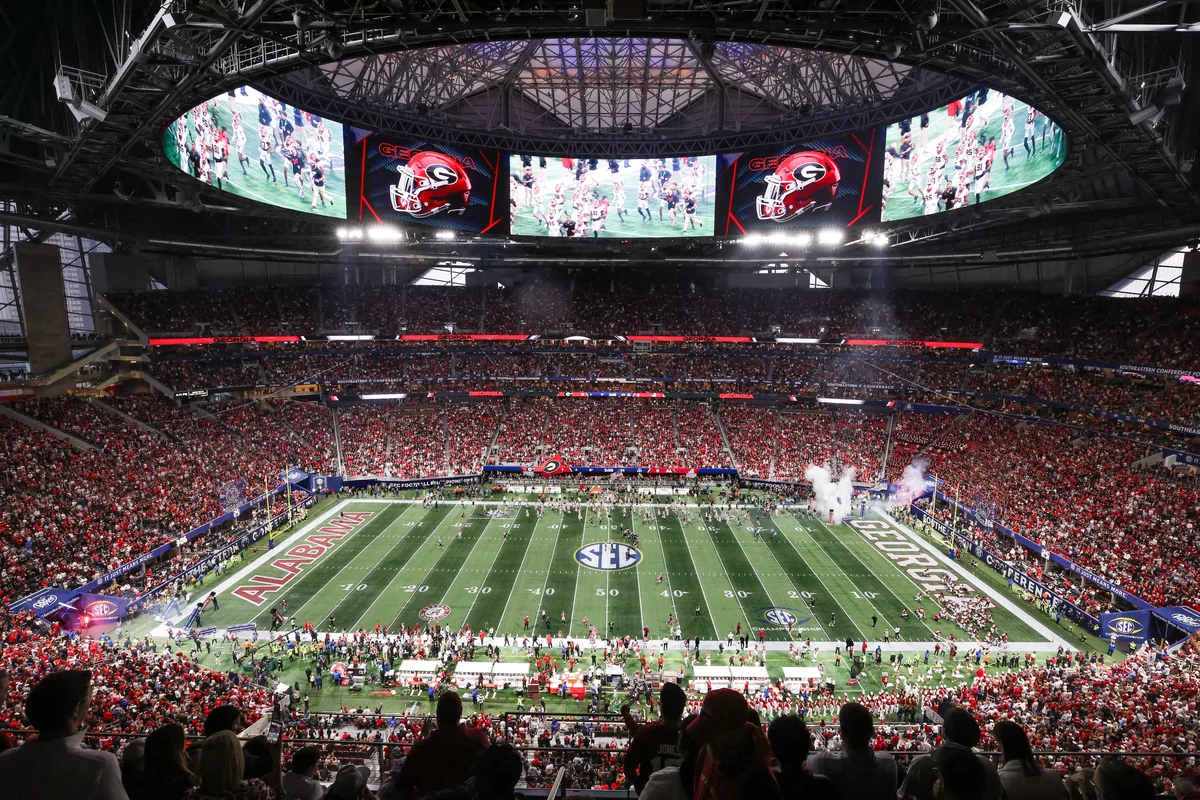
How to read the SEC football standings
Updated November 26, 2026. Start with the conference column when you want to know who is going to Atlanta. The SEC puts all 16 teams in one table and sends the two with the highest conference winning percentages to its championship game. In the final weeks, a score from the lower half of the conference can settle a tie near the top. The rules tell you which scores to watch and when to stop counting.
Winning percentage is especially useful when one team has played more SEC games than another. A 6–2 team has won 75 percent of its league games. A 6–3 team has won two-thirds. Both rows show six SEC wins, yet they represent different positions at that moment. Once both have played nine conference games, comparing their win totals is enough to spot an equal percentage. A championship tiebreaker becomes relevant when that equality affects who qualifies or how the two qualifiers are seeded.
| Team | SEC record | SEC win percentage | Overall record |
|---|---|---|---|
| Team A | 6–2 | 75.0% | 9–2 |
| Team B | 6–3 | 66.7% | 9–3 |
Team A is ahead in the first comparison. If it loses its ninth SEC game, it will join Team B at 6–3. That is the point at which you would look up head-to-head or the next applicable rule, assuming a title-game place or seed is at stake. Updates during a Saturday slate remain provisional until the relevant games go final. The official SEC standings are the place to confirm the conference records before starting a calculation.
Which games count toward the SEC record?
Starting in 2026, each team has nine conference games on its regular-season schedule. Three opponents recur annually and six rotate through the other league members. Over a two-year span, the rotation gives each team a game against every other SEC program. That leaves room for unequal opponent lists in a single season, even when everyone has the same number of league games. It also explains why the rulebook sometimes has to move past a direct meeting and compare games against shared opponents.
Check the opponent's place on the SEC schedule before assigning a result to the conference column. Georgia and Florida can meet at a neutral venue and still play an SEC game. Georgia and Georgia Tech can play an annual rivalry with regional bragging rights and national rankings at stake, and that game goes only in the overall record. The league's opponent rotation guide identifies both kinds of rivalry. A scoreboard's network, venue or television window tells you where to watch. The schedule tells you which games move the SEC standings.
Why a national ranking can be higher than a team's place in the SEC
Consider two teams that finish 6–3 in the league. One is 9–3 overall and the other is 8–4. The extra win is part of the first team's season résumé and can matter to a national voter. In Atlanta's race, both start with the same conference percentage. If the 8–4 team won their direct meeting and the berth comes down to those two teams, it has the relevant head-to-head result.
This is also why a ranked team can need help from an unranked opponent in late November. The AP voters, coaches and playoff committee each evaluate teams for a national list. The league office applies its standings procedure to allocate two specific places. Use the national rankings comparison when the question is how the same team appears in different polls. Use the league table and opponents' results when the question is who gets the ticket to Atlanta.
How the SEC breaks a tie for a championship spot
Write down the teams with the same league percentage and count the berths they are competing for. A tie for second behind a clear leader leaves one opening. A group tied for first can be competing for both. The SEC's football tiebreaker procedure has separate instructions for those situations. They share an order of tests, and the league moves down the list as far as the tie requires.
- Compare the direct games among the teams in the tie.
- Compare each team's full record against SEC opponents shared by the group.
- Compare results against the best-placed shared opponent, then work down the league standings as needed.
- Compare the league winning percentages of the full conference schedules each tied team faced.
- Use the league's capped, opponent-adjusted scoring margin across SEC games.
- Resolve a tie that survives the earlier steps by a random draw.
Head-to-head and the common-opponent tests
A completed game gives the fastest answer when just two teams are tied for one place. A three-team tie can look very different. If all three met, the conference can make a table from those games alone. When the matchup list is incomplete, the rule also accounts for a team that beat everyone in the group or lost to everyone. A single win over one other contender has limited reach when the third team was absent from that matchup.
Suppose two 6–3 teams skipped each other in the rotation and went 1–1 against their two shared opponents. Team A beat the opponent that finished 7–2 and lost to the one that finished 4–5. Team B did the reverse. Their combined records against the shared pair are equal, so the league compares the result against the 7–2 opponent first. Team A advances. The league would compare the next shared opponent only if the first comparison left them level. The positions of those opponents come from league results.
The official document also covers a tie among the shared opponents themselves. The conference first sees whether head-to-head can establish their order. If those opponents are still even, the contenders' records against the relevant shared opponents at that level are combined. That safeguard matters when a standings page lists two opponents on separate lines with the same record. The display order alone gives you no reason to value a win over one more highly than a win over the other.
When opponent winning percentage comes into play
If the common-opponent tests leave a tie, the calculation expands to every conference opponent on each contender's schedule. For a simple example, imagine two nine-opponent lists in which every opponent has completed nine SEC games. One list combines for 42 conference wins in 81 games, about 51.9 percent. The other has 40 wins in 81, about 49.4 percent. The first contender wins this step. It can benefit when an SEC opponent wins a game elsewhere in the league, even when that opponent is out of the title race.
If those percentages are still equal, the scoring step compares game scores relative to the opponents' typical offense and defense, then aggregates the capped figures across league play. Appendix A of the official rules explains how the limits work. A scoreboard tally of every point scored this fall would answer a different question. The draw comes last, after these football results and scoring comparisons have been exhausted.
What changes when one team drops out of a multi-team tie
Imagine three teams tied for second and only one direct game among them. Team A beat Team B, while Team C played neither. Head-to-head alone leaves all three in the original comparison. If A and B share the best record against common opponents and C falls below them, the remaining two start at the top of the two-team procedure. Now A's win over B settles the berth. The result on the field stayed the same. The set of teams that result has to separate changed.
In a tie for first, a step can put one team in the game and send the remaining teams still in contention back to the beginning of the procedure for second. If a comparison leaves exactly two teams tied for first with both championship places available, those teams are in. The two-team process then assigns the home and away designations in Atlanta. Before reading any tiebreaker result, ask whether it settled qualification, seeding, or the smaller group that still has work to do.
The 2026 race for the second spot in Atlanta
The November 26 standings give a useful test. Georgia has clinched the first place in the game. Texas, Alabama and Tennessee are all 6–2 in SEC play with one conference game left. A head-to-head sweep through the three names looks tempting because Texas beat Tennessee and Tennessee beat Alabama. Texas and Alabama did not meet. Which teams finish with equal records determines how much each October or September result can do.
How Georgia secured its place
Georgia finished its SEC schedule with a 34–6 win at South Carolina on November 21. The league confirmed Georgia's berth the following day. At 8–1 in conference play, the Bulldogs sit above contenders who can finish 7–2 at best. Georgia Tech is still on the regular-season slate. The in-state game can add to Georgia's full record and influence the national picture without changing its league finish. The SEC Championship game guide has the December 5 venue and viewing details.

What to track for Texas, Alabama and Tennessee
Friday offers the first two relevant results. Mississippi State visits Ole Miss at noon Eastern Time, then Texas visits Texas A&M at 7:30 p.m. ET. Both games are on ABC. On Saturday, LSU visits Arkansas at 12:45 p.m. ET on SEC Network. Tennessee at Vanderbilt starts at 7 p.m. ET on ESPN, and Auburn at Alabama follows at 7:30 p.m. ET on ABC. The official SEC listings and the weekend schedule are the places to check for updates.
- Texas wins and either Tennessee or Alabama loses. Texas advances. It has a direct win over Tennessee. If the two teams at 7–2 are Texas and Alabama, the Longhorns would be 4–0 against their four shared SEC opponents, ahead of Alabama's 3–1.
- Texas loses and Tennessee wins. Tennessee advances. If Alabama also wins, the Volunteers' 26–10 win over the Crimson Tide settles their shared 7–2 finish.
- Texas and Tennessee lose, and Alabama wins. Alabama takes the remaining place outright at 7–2.
If all three win, each finishes 7–2 and each has beaten both LSU and Texas A&M, the two opponents common to the whole group. The direct results and shared-opponent tests leave them together. The SEC then compares the winning percentages of their nine league opponents. Here is what that arithmetic produces from the conference schedule and the results entering the weekend. Each figure counts opponent wins out of 81 SEC games.
| Egg Bowl winner | LSU–Arkansas winner | Texas | Alabama | Tennessee | Advances |
|---|---|---|---|---|---|
| Mississippi State | LSU | 36 | 37 | 35 | Alabama |
| Mississippi State | Arkansas | 36 | 36 | 35 | Texas after reset |
| Ole Miss | LSU | 36 | 36 | 35 | Texas after reset |
| Ole Miss | Arkansas | 36 | 35 | 35 | Texas |
Texas played both teams in each of those two games, so each game adds one win to its opponent pool whichever way it goes. Alabama played Mississippi State and LSU. It gains the most if both win. In the two rows where Texas and Alabama land on 36, Tennessee drops out. The league starts the two-team procedure again. Texas gets the edge in the broader four-opponent comparison, which now includes Tennessee and Mississippi State alongside LSU and Texas A&M.
If all three lose, Oklahoma's game at Missouri adds one more wrinkle. An Oklahoma win puts the Sooners into the 6–3 group. Texas falls out on results against Texas A&M, and Alabama has the better results against South Carolina and Texas A&M, the opponents shared by the remaining three. If Missouri wins, Oklahoma stays below the tie. Texas falls behind Alabama and Tennessee on results against LSU and Texas A&M, and the reset sends Tennessee through on its win over Alabama. Check the scoreboard for final results before treating any of those branches as settled.
What an SEC Championship berth means for the playoff
A berth in Atlanta means a team can win the SEC and claim one of the automatic places in the 2026–27 College Football Playoff. The 12-team format includes automatic bids for the SEC, ACC, Big Ten and Big 12 champions and a place for the highest-ranked team from the six other specified FBS leagues. The remaining field comes from the national selection process, including the provision for Notre Dame if it lands in the final top 12. Getting to Atlanta settles the opportunity to win the conference's automatic bid. The game still has to be played.
The runner-up can earn an at-large berth. So can an SEC team whose conference record or tiebreaker kept it out of the championship game. There is no limit on the number of entrants from one conference. Consider what would happen if a team takes third in the SEC after losing the opponent-percentage comparison by one combined opponent win. That decides which team spends December 5 in Atlanta. The playoff committee still considers the third-place team's own wins, losses and schedule alongside the other teams competing for a place. One opponent's result in the league formula is just one piece of evidence in that wider evaluation.
The next question is seeding. The committee's four highest-ranked teams get first-round byes. Teams seeded fifth through eighth host first-round games. An SEC champion can be in the field and still have to play in the opening round. A possible at-large qualifier can also be high enough in the final rankings to earn a bye. The SEC's home designation for the conference championship applies to the game in Atlanta. The committee's final seed sets the playoff path.
During the last week of the regular season, follow the league table for the Atlanta race and the rankings comparison for the national picture. The CFP's November 24 release lists December 1 at 7 p.m. ET for the next interim rankings. The committee then reviews championship weekend before announcing the field on December 6. Until then, the projected bracket is a way to see how today's order would map to byes and host sites. It will become a different kind of reference once the final field is in.
Loading comments...