Updated November 17, 2026. Georgia leads the AP Top 25 published November 16, with Utah, Notre Dame and UCLA next. This Week 12 guide preserves that released poll, explains the changes beneath the leaders and pairs the ranking discussion with confirmed November 21 viewing choices.
AP Top 25 for Week 12: the complete November 16 poll
The AP's November 16 release leaves Georgia at the front of the field, followed by Utah, Notre Dame, UCLA and Miami. No team changes places in the first nine positions. The notable disruption begins immediately afterward: Wake Forest takes the final top-ten spot, with Texas Tech moving to eleventh.
This is the ballot entering the November 20-21 games. It includes the completed November 13-15 slate, rather than predicting what will happen next Saturday. The date also distinguishes it from the preceding November 8 edition and from a separately published College Football Playoff ranking.
| Rank | Team | Record | Points | Previous AP rank |
|---|---|---|---|---|
| 1 | Georgia | 9-1 | 1734 | 1 |
| 2 | Utah | 10-0 | 1677 | 2 |
| 3 | Notre Dame | 9-1 | 1584 | 3 |
| 4 | UCLA | 10-0 | 1552 | 4 |
| 5 | Miami | 9-1 | 1426 | 5 |
| 6 | Indiana | 9-1 | 1384 | 6 |
| 7 | Alabama | 8-2 | 1297 | 7 |
| 8 | Texas | 8-2 | 1290 | 8 |
| 9 | Tennessee | 8-2 | 1179 | 9 |
| 10 | Wake Forest | 9-1 | 1134 | 11 |
| 11 | Texas Tech | 9-1 | 1081 | 10 |
| 12 | BYU | 8-2 | 1038 | 12 |
| 13 | Iowa | 8-2 | 861 | 16 |
| 14 | Oregon | 7-3 | 820 | 18 |
| 15 | Boise State | 9-1 | 767 | 17 |
| 16 | Ohio State | 7-3 | 661 | 21 |
| 17 | Kentucky | 7-3 | 599 | 13 |
| 18 | USC | 7-3 | 546 | 15 |
| 19 | Arizona | 7-3 | 404 | 22 |
| 20 | Houston | 7-3 | 365 | 14 |
| 21 | Louisville | 7-3 | 357 | NR |
| 22 | Liberty | 9-1 | 183 | NR |
| 23 | Florida | 6-4 | 173 | NR |
| 24 | Memphis | 8-2 | 138 | NR |
| 25 | Ole Miss | 6-4 | 103 | 19 |
The points column helps reveal differences a numbered list hides. Alabama and Texas are separated by seven points, even though their positions look just as distinct as any other adjacent pair. Georgia's advantage over Utah is 57 points. Those gaps describe this ballot's totals; they are not point spreads for a game and do not measure how many points one team would beat another by.
For the previous-rank column, NR means outside the published top 25. That label is particularly important for Louisville, Liberty, Florida and Memphis. Receiving votes below the cutoff does not award an official ranking of twenty-sixth or worse. A numerical leap can be stated precisely for Ohio State, from twenty-first to sixteenth, but the four entrants should be described as entering or returning to the list.
Records likewise supply context without explaining the entire ordering. UCLA has no defeats and is fourth; Notre Dame has one and is third. Alabama and Texas each have two and sit ahead of 9-1 Wake Forest. The ballot is a comparison of seasons as judged by voters, not a table sorted automatically by winning percentage.
Use the current college football rankings when looking for a subsequent release. The table here retains the November 16 edition so that its movement and its upcoming-game discussion remain understandable after the calendar advances.
Four contenders, four ways to protect a ranking
The top four all won, but a shared result in the standings conceals four different performances. Their latest games are useful comparisons precisely because the poll did not react by reshuffling them. A comfortable favorite, a narrow road survivor and two other established contenders all kept their numbered places.
Georgia and Utah defend different cases
Georgia beat Missouri 48-21 at home and stands 9-1. The Bulldogs collected 58 first-place votes in the new AP edition. Utah, still unbeaten at 10-0, received ten. That distribution makes Georgia the clear preference of most voters, but it leaves a substantial difference between a strong consensus and unanimity.
Utah's 40-39 victory at Arizona illustrates why a one-point result deserves more careful treatment than a quick glance at the margin. The Utes maintained an unbeaten season away from home. Arizona then rose three positions in the poll despite losing. The ballot therefore did not treat either side of that game as if the final margin alone explained its quality.
Our interpretation is that Georgia's latest performance reinforces an already established lead, while Utah retains the straightforward distinction of having no losses. That is a comparison of the evidence, not an assertion that voters all used identical criteria. A ballot is the combined result of many judgments, and the next set of games can alter those judgments without any published formula requiring a particular exchange.
Notre Dame and UCLA preserve the chase
Notre Dame supplied a 41-7 win over Boston College and moved to 9-1. Two voters put the Irish first, even though the overall list kept them third. That small first-place constituency matters as a sign of disagreement within the ballot, but it is not a promise that a promotion is coming. The Notre Dame schedule shows the remaining opportunities to add to the argument.
UCLA beat Illinois 22-14 on Friday, November 13, and reached 10-0. Its fourth position leaves two unbeaten teams among the first four, with one-loss Notre Dame between them. The order is a useful reminder that an undefeated season is powerful evidence rather than an automatic instruction to rank a team above every school with a defeat.
For these contenders, defending the current position and improving it are related but separate objectives. A win keeps a case alive. A higher-ranked rival's loss may create room. A comparison can also change when the significance of an earlier opponent changes. None of those possibilities tells us what a future ballot will say before the remaining games have supplied their results.
Which teams gained ground and which lost it
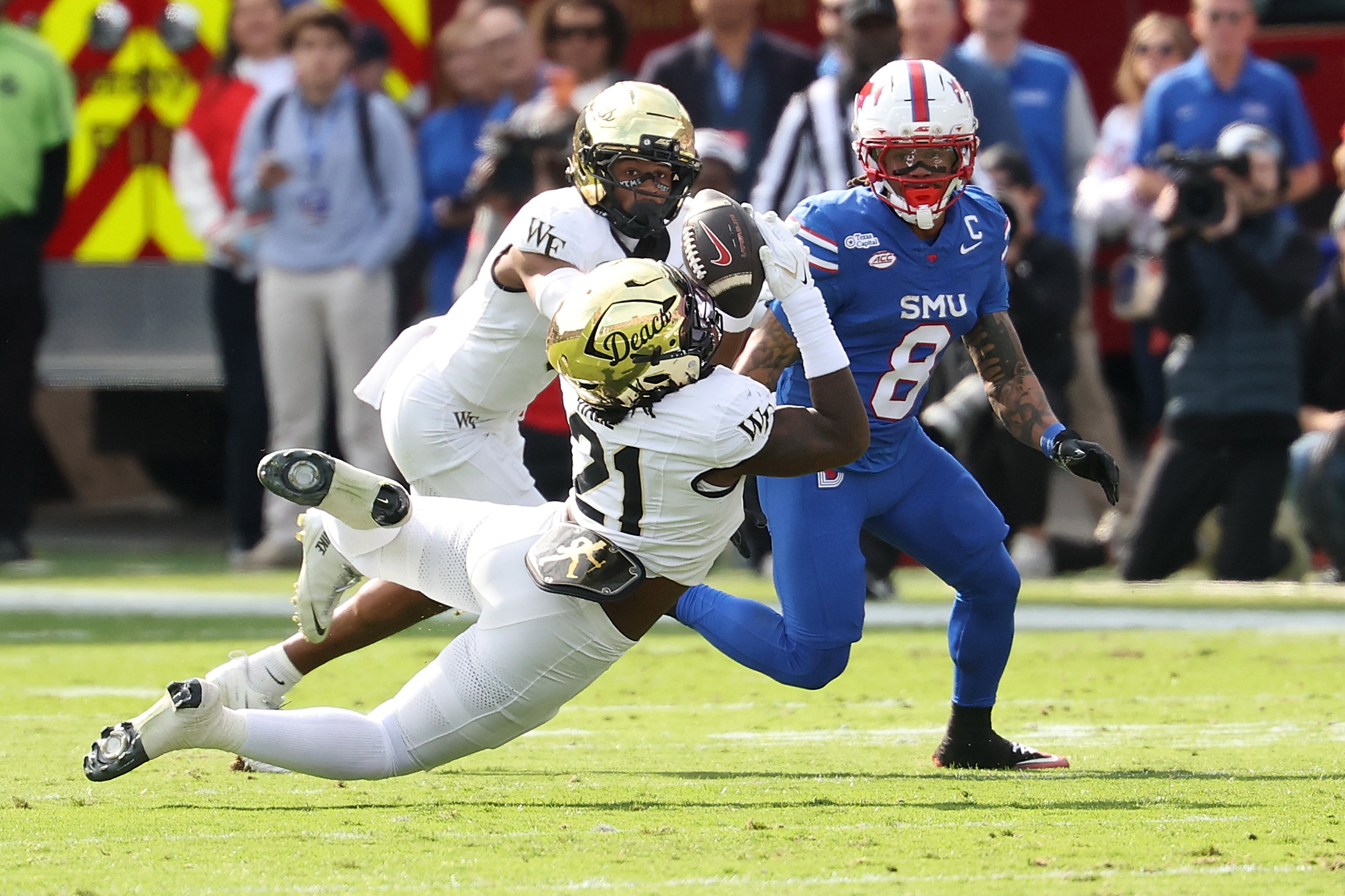
Wake Forest's 49-7 victory at SMU supplies the clearest top-ten development. The Demon Deacons rose from eleventh to tenth, exchanging positions with Texas Tech. A one-place move may look small in a change column, but crossing that boundary changes which group of teams a casual reader sees first. The stronger analytical point is the result behind it: a decisive victory away from home.
Other upward moves require different explanations. Iowa climbs three places to thirteenth, Oregon four to fourteenth and Ohio State five to sixteenth. Arizona also rises three spots, to nineteenth, after losing to Utah. That last case warns against reading every upward arrow as shorthand for a win. Voters can revise a comparison favorably after a defeat when the performance and the wider week's results change their assessment.
Read new entries differently from numerical jumps
Louisville at No. 21, Liberty at No. 22, Florida at No. 23 and Memphis at No. 24 were all outside the preceding top 25. Those additions remove South Carolina, New Mexico, LSU and SMU from the numbered table. For a fan tracking the lower edge of the ballot, these exchanges may matter more than a stable top five.
Keep the language precise. Ohio State's five-place increase is measured between two official positions. Saying an unranked entrant jumped seven or nine places assumes a numbered extension that the published AP top 25 does not provide. Describe an entry as new or returning, then discuss its record and recent result instead of manufacturing a larger movement.
Florida's 21-14 win at Kentucky offers a particularly clear connection between two changes. Florida returns at 6-4, while Kentucky drops from thirteenth to seventeenth at 7-3. The same game adds to one team's case and weakens another's. That connection is more informative than treating their movement as unrelated arrows.
Houston and Ole Miss have the largest declines among teams remaining ranked in both editions: six places each. Their new positions are twentieth and twenty-fifth. The bottom spot is especially exposed to the next week's comparisons, but the table does not tell us how the next vote will fall. A ranking change records an assessment already made; it cannot supply a future result or a formal playoff verdict.
The AP poll is a guide to the race, not the playoff bracket
One of the easiest mistakes in November is to draw a line below the twelfth team in an AP table and call everything above it the playoff field. That is not how this list functions. The AP vote describes the opinion of its media panel. The CFP selection committee publishes a separate ranking and is responsible for establishing the playoff bracket.
BYU's twelfth place here is therefore not a confirmed twelfth seed. Boise State's fifteenth place is not an exclusion notice. The teams have different conference circumstances, and the final postseason decisions require the committee's own work. A media ranking can be a useful measure of national perception without becoming the operative selection list.
Ohio State and Boise State illustrate why the distinction matters. Ohio State is 7-3 and sixteenth; Boise State is 9-1 and fifteenth. Their adjacent AP positions do not make their remaining paths identical. Nor does being one place apart mean that a result involving one school must produce a matching consequence for the other. Their opponents, conference situations and the committee's eventual comparisons still matter.
Use the rankings comparison page to place the lists beside each other, keeping their dates visible. An AP edition incorporating the latest weekend and a CFP edition published before that weekend do not describe exactly the same evidence. Some apparent disagreement can reflect timing as well as different evaluators.
The CFP's committee overview identifies December 6 as Selection Day for the final rankings and bracket. Until then, interim lists help explain the developing discussion rather than settle the outcome. This article's analysis should be read on that basis: it identifies changing AP positions and games worth following, without claiming to award postseason places.
For the longer explanation of voters, methods and consequences, see the AP, Coaches and CFP guide. The practical rule for this week is shorter: use AP numbers when discussing this table, and switch explicitly to the committee's numbers when discussing its own ranking. Mixing the two can make an otherwise accurate matchup description misleading.
Five Saturday games to put beside the rankings
A ranking becomes a better viewing guide when it is paired with a specific next assignment. The five games below focus on teams in the AP top ten, rather than attempting to reproduce every Week 12 matchup. All are scheduled for Saturday, November 21. Numbers are from the November 16 AP edition, and every kickoff is Eastern Time.
| Game | Kickoff ET | TV or stream |
|---|---|---|
| No. 10 Wake Forest at Georgia Tech | Noon | ESPN |
| No. 4 UCLA at Michigan | 3:30 p.m. | CBS |
| No. 1 Georgia at South Carolina | 7:30 p.m. | ABC |
| SMU at No. 3 Notre Dame | 7:30 p.m. | NBC / Peacock |
| No. 2 Utah at TCU | 9 p.m. | FOX |
Wake Forest offers the first test of a newly improved position. Its game begins at noon, before the afternoon choice involving unbeaten UCLA. For viewers following the top-ten boundary as closely as the first-place race, that is a useful starting point. A team does not need to be first or second to produce a consequential comparison for the next ballot.
UCLA's trip to Michigan follows at 3:30 p.m. ET on CBS. The Bruins bring a 10-0 record into a road setting, a different assignment from their preceding home victory over Illinois. Our reason for highlighting it is the combination of an unbeaten contender and a road game, not a prediction that the game must be close.
Choose around the overlapping prime-time starts
The main evening conflict arrives at 7:30 p.m., when Georgia visits South Carolina on ABC and Notre Dame hosts SMU on NBC and Peacock. Choose one as the main screen before kickoff if you want to follow a game continuously. A second screen can help monitor the other, but only if you have the required feed and your service supports the way you intend to use it.
Utah starts at 9 p.m. ET on FOX, while those earlier games may still be in progress. Utah's announcement uses 7 p.m. Mountain Time, and TCU's announcement uses 8 p.m. Central. Those descriptions agree: they are the same kickoff expressed in different zones. A viewer who drops the zone labels could mistakenly plan an evening around three different start times.
Keep the AP labels separate from numbers shown in a broadcaster's weekly release. A television announcement can use the CFP edition that was current when it was prepared. It can therefore display a different rank beside the same team without changing the game, the channel or the AP table here.
The Week 12 schedule supplies the wider slate, and the TV schedule is the place to check later assignments. Recheck before settling into your chosen window. The purpose of this selection is to make the ranking discussion actionable, while leaving the complete national schedule to the tool designed for it.
Read the next poll with the dates attached
The November 16 date is more useful than an unlabeled Week 12 screenshot. The AP postponed this release until Monday after travel disruption pushed the Ole Miss-Oklahoma game into Sunday. A reader checking at the usual Sunday point could have found a prediction or an older poll instead of the completed new ballot.
Publishers can also describe the same edition in different ways: after Week 11, or entering Week 12. Neither label alone establishes that one table is newer. Check the release date first, then the completed games represented in it. That approach is especially useful when a search result preserves a headline after a page has been updated.
For a movement comparison, keep the poll identity constant. A team's change between two AP editions is a weekly AP change. The distance between its AP and CFP positions is disagreement between two lists. Subtracting the latter pair and calling it a rise or fall gives the reader the wrong explanation, even when both individual numbers are correct.
Keep a separate record of game status as well. A matchup appearing on next Saturday's schedule has not supplied a final result. The scores page lets you choose a date or week and narrow the results to FBS or AP Top 25 teams. Use those completed results when explaining a later ballot, rather than carrying an advance expectation into the historical account.
The preceding Week 11 rankings analysis remains available for the November 8 picture. Keeping the two editions separate makes the developments visible: the new top-ten exchange, Ohio State's rebound, the returning teams and the departures. When the next poll arrives, compare it with this one using the same dated approach. That provides a clearer account of the race than silently replacing an older table and losing the reasoning attached to it.
Loading comments...